Notice: Function _load_textdomain_just_in_time was called incorrectly. Translation loading for the js_composer domain was triggered too early. This is usually an indicator for some code in the plugin or theme running too early. Translations should be loaded at the init action or later. Please see Debugging in WordPress for more information. (This message was added in version 6.7.0.) in /var/www/vhosts/gtfoodandtravel.com/httpdocs/wp-includes/functions.php on line 6260

Notice: Function _load_textdomain_just_in_time was called incorrectly. Translation loading for the woosidebars domain was triggered too early. This is usually an indicator for some code in the plugin or theme running too early. Translations should be loaded at the init action or later. Please see Debugging in WordPress for more information. (This message was added in version 6.7.0.) in /var/www/vhosts/gtfoodandtravel.com/httpdocs/wp-includes/functions.php on line 6260

Deprecated: The called constructor method for WP_Widget class in Widget_Include_Post is deprecated since version 4.3.0! Use __construct() instead. in /var/www/vhosts/gtfoodandtravel.com/httpdocs/wp-includes/functions.php on line 6260
Blog – Page 5 – GT Food & Travel
Notice: Function WP_Scripts::add was called incorrectly. The script with the handle "hero-animator" was enqueued with dependencies that are not registered: hero-rocket-mode, hero-hover-elements. Please see Debugging in WordPress for more information. (This message was added in version 6.9.1.) in /var/www/vhosts/gtfoodandtravel.com/httpdocs/wp-includes/functions.php on line 6260

Category: Blog

  • Sicily Part 3 – Etna with The Etna Wine Lab

    Sicily Part 3 – Etna with The Etna Wine Lab

    This is part 3 of a 3 part post of my favorite memories from my last trip to Sicily. You’ll find Part 2 here.20140515-ivignerietna2

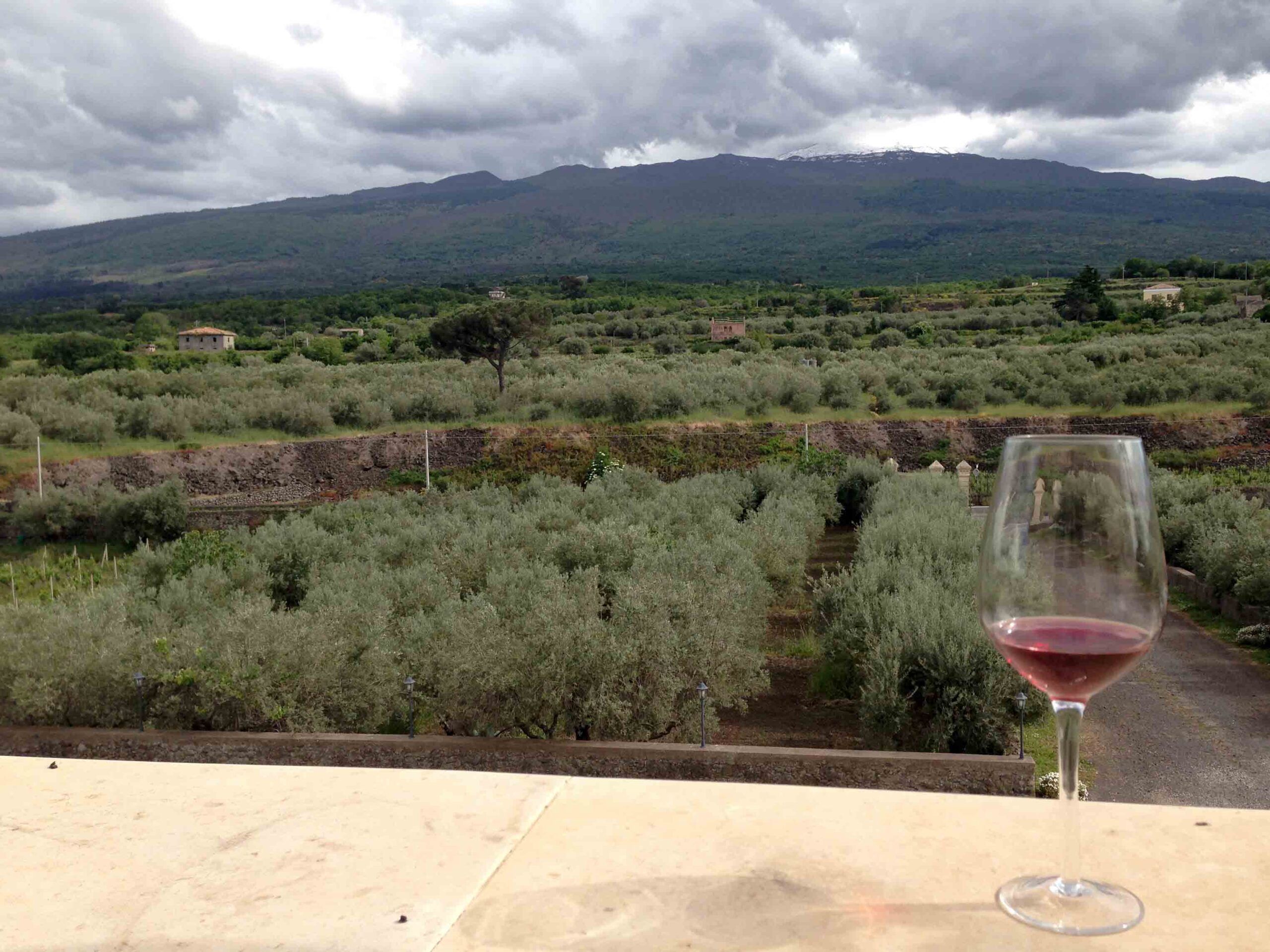
    We sped off leaving I Vigneri in the distance…two more vineyards to visit. I was floating on cloud 9…for the rest of the day I watched my family digest a small piece of Etna. While we wandered amongst the alberello vines in the morning, the afternoon brought us indoors to the retired wine making facilities of Feudo Vagliasindi and the modern tasting room at Planeta. A complete contrast to I Vigneri, Feudo Vagliasindi is a hotel and farm that produces organic Etna Rosso wine and olive oil. FeudoVagliasindi2Feudo Vagliasindi is also home to a palmento, a traditional stone structure where wine was made, it often has an area for foot pressing of the grapes, permanent stone containers and barrels for aging. With the arrival of modern wine making technology and strict hygienic standards, the use of palmenti is banned by European law. Although no longer in use many of these buildings still exist in Sicily. Valeria explained in simple terms how it was utilized. Harvested grapes were transported quickly from the vineyards and were carried in through the windows beside the basket press (pictured below).

    Vagliasindi

    All eyes moved from the press to the wooden beam and enormous screw hovering above us. The screw would have rotated the stone block pressing every last precious drop of juice from the grape skins. No room for waste.

    palmento

    In the adjacent room 100+ liter chestnut barrels that date back to the 19th century stand. They too played an important role in the palmento. After grapes were crushed the juice flowed first to stone tanks to ferment and then to this level where it was transferred to the chestnut barrels.

    chestnutbarrels

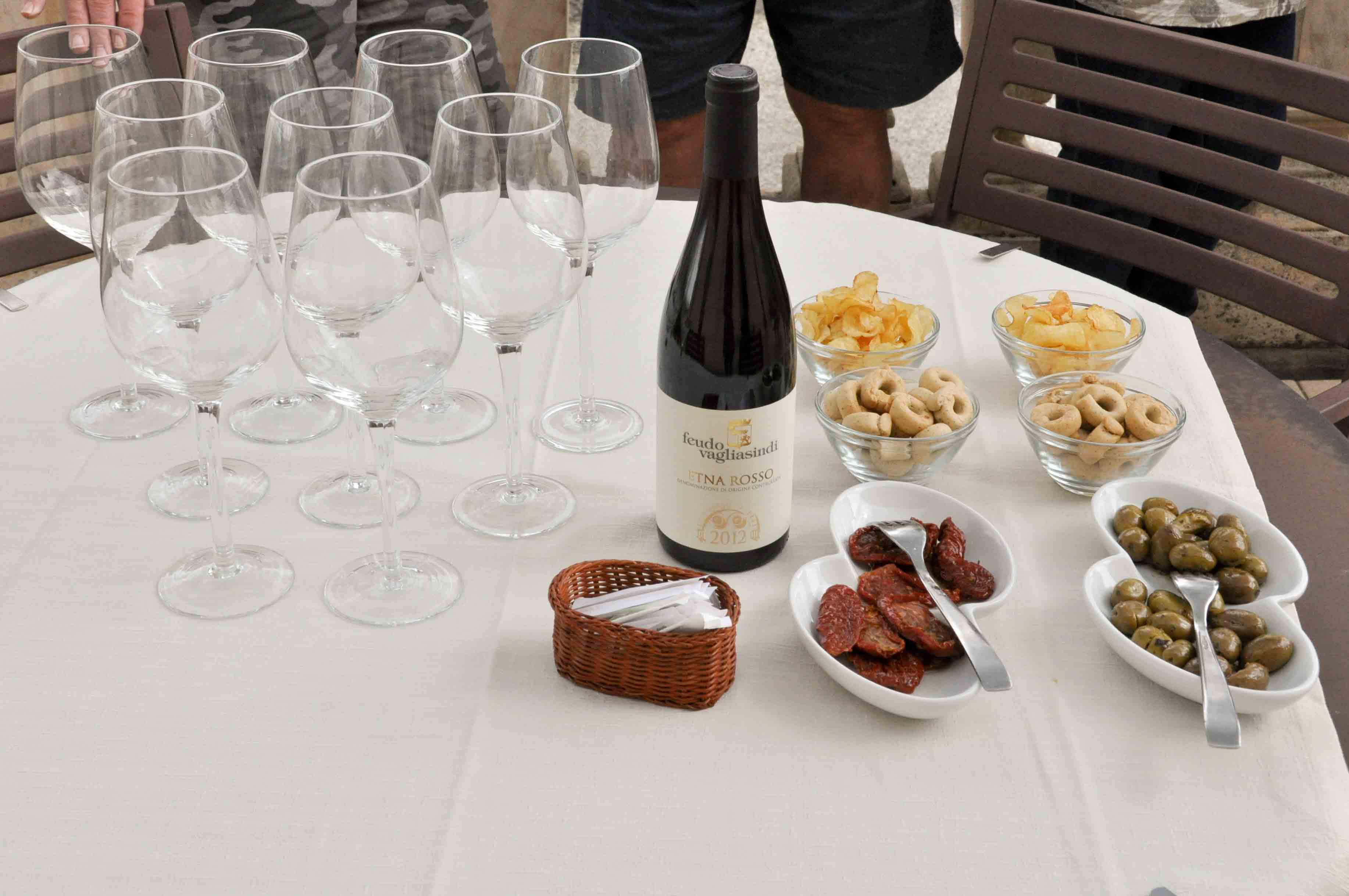
    After our historic wine making lesson, we tasted Feudo Vagliasindi’s Etna Rosso 2012. It had nice acidity, red-fruit flavors and expressive tannins, a straightforward wine. I look forward to tasting it in a few years time. FeudoVagliasindiOur last visit was at Planeta, a new comer to Etna but no stranger to Sicilian wine production. The Hospitality Manager, Vera Russo greeted us warmly. As we toured Planeta’s state of the art facilities, Vera explained the modern wine making process giving us a chance to compare and contrast how wine was made in the palmento and how it is made today at Planeta. Planeta’s renovated palmento serves as a showroom for the complete line of Planeta’s wine.
    planetatorchio

    We tasted two wines from Etna and 3 others. Vera described each wine to the group and answered all of our questions. I was most interested in tasting Eruzione 1614 Carricante and Eruzione 1614 Nerello Mascalese. The wines spoke of a tame Etna, easy drinking and clean. Everyone at the table enjoyed the tasting.

    PlanetawVeraplanetabottlelineupPlanetawineglasses

    The tour was perfect for our group. It combined history, food and wine tastings, the people behind the wine, trends and most importantly we had a blast!

    Are you an Etna wine lover like me? Do you have a favorite Etna wine?
  • 5 Holiday Breads

    5 Holiday Breads

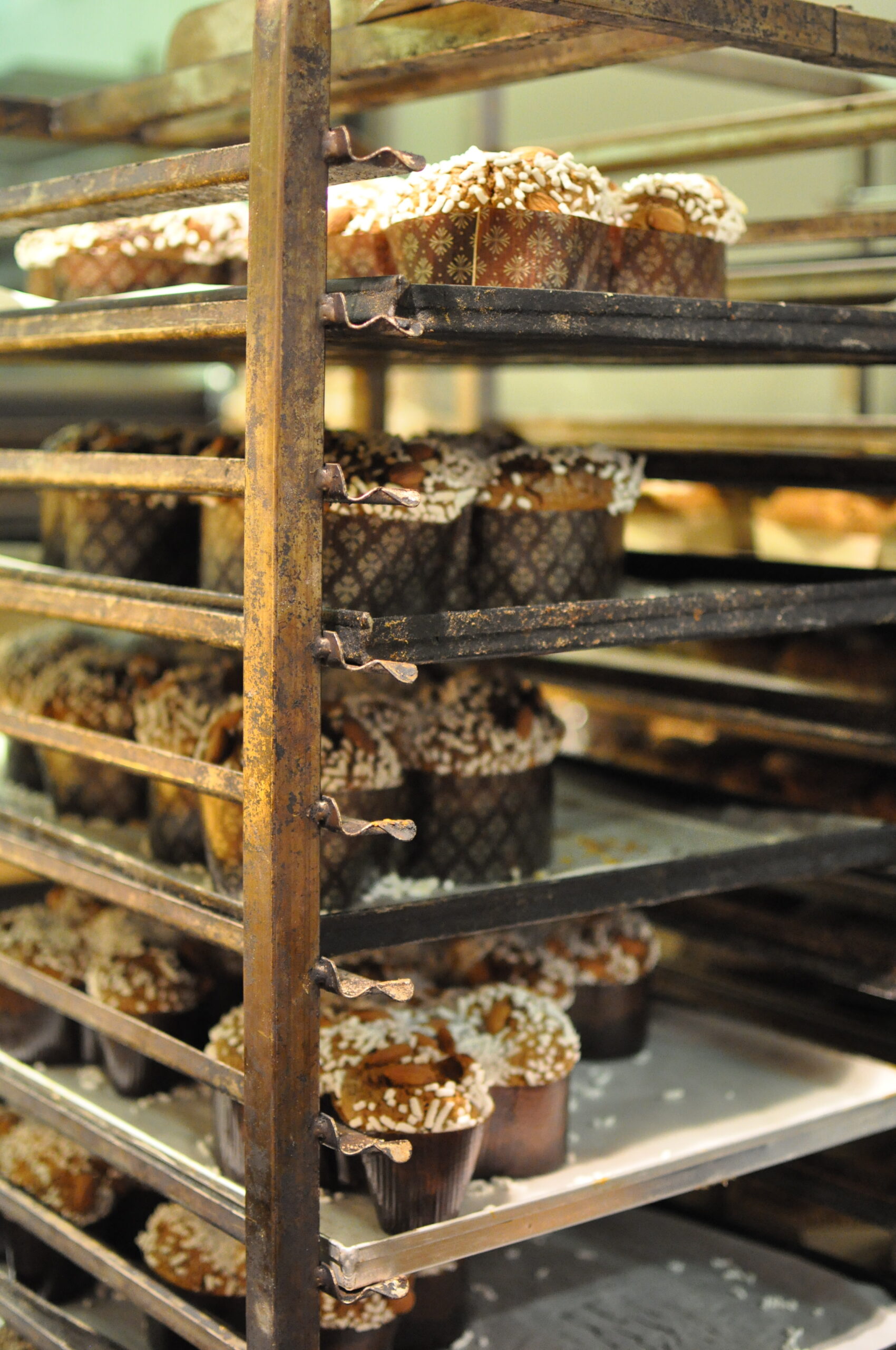
    While most people know Italian food for its divine pizza, pasta, and gelato, many are unaware that Italy also boasts an impressive variety of holiday breads in its culinary repertoire. In fact, Italy has a longer tradition of holiday breads than any of the aforementioned foods!panettoneRoscioli

    Here is a list of five must-try sweet breads when visiting Italy during the holidays:

    Panettone – originally from Milan, this sweet bread contains candied orange, citron, and lemon zest. It is often served with a sweet hot beverage or sweet wine, and is the most well-known Italian holiday bread.

    Pandoro – called pan d’oro (literally, “golden bread”) for its long history as the choice holiday treat of Italian nobles and aristocrats since the 1st century B.C. It’s a star-shaped sweet bread that is dusted with vanilla-scented icing sugar, so that it resembles the snowy peaks of the Italian Alps during Christmas.

    Panpepato – the most versatile of the Italian holiday breads, panpepato has a wide range of possible ingredients, including almonds, hazelnuts, pine nuts, pepper, cinnamon, nutmeg, orange zest, cocoa, and honey. Each family’s recipe is different! (And they will all tell you it’s the best)

    Panforte – hailing from Siena, panforte is the predecessor of the American fruitcake. Panforte translates to “strong bread,” probably in reference to its peppery flavor (in fact, it used to be called panpepato, “peppered bread”). It is made by dissolving sugar in honey, then mixing in flour, nuts, fruits, and spices.

    Pangiallo – Lazio’s contribution to the holiday bread catalog. Made from a mixture of dried fruit, honey, and cedar candy, its invention dates all the way back to Imperial Rome.

    pangiallo uned

    For a taste of any one of these freshly baked breads, check out Forno Roscioli or Panificio Bonci!

  • Dining in Rome During the Holidays

    Dining in Rome During the Holidays

    Visiting Rome during Christmas and New Year’s comes with its own set of challenges, one of which is finding a restaurant at which to share a special meal with loved ones. But not to worry – we’ll save you the trouble of sifting through dozens of prix fixe menus and opening hours. Any of the restaurants on our list of holiday dining options are sure to make your Christmas or New Year’s in Rome unforgettable!

    Antico Arco offers a €220 prix fixe menu on New Year’s Eve, and is open for lunch and dinner on December 24, 25, and 31.

    Though closed on Christmas Day, Il Baccoco has specially prepared an a la carte menu for dinner on New Year’s Eve, and is open for dinner on December 26 as well.

    Cheese lovers will be happy to know that Beppe e I Suoi Formaggi will be be open for breakfast and lunch on December 24 and December 31. For a complete list of December opening hours visit their contact page.

    Casa Bleve will be serving a €115 prix fixe menu for dinner on December 31. They are open for dinner only on December 25, then open for lunch and dinner the 26th. In December they are closed every Sunday.

    For mouthwatering fried starters, authentic Roman pasta dishes and gorgeous wine, Cesare al Casaletto is serving up lunch on Christmas and New Year’s Days.

    Metamorfosi is also offering a fish-based menu on Santo Stefano (December 26), and is open for dinner on New Year’s Eve with a €220 prix fixe menu, excluding drinks. On New Year’s Day, Metamorfosi is open for lunch only.

    Romeo is closed from after lunch on December 24 until December 27. But check back for their New Year’s Eve prix fixe menu cooked up by renowned chef Christina Bowerman.

    Roscioli is open for lunch on Christmas Eve and New Year’s Eve.

    Finally, Il San Lorenzo is hosting a traditional fish-based feast on Christmas Eve. They are open for dinner only on New Year’s.

    Aside from the above options, most restaurants in the Jewish Ghetto will remain open throughout Dec. 24-26. Calling far in advance to reserve a table is your best bet for a stress free holiday dinner. The listed openings have been confirmed many times but PLEASE  call all restaurants in advance. Opening hours sometimes change at the last second. Happy Holidays, eat, drink and be merry!

    Happy holidays – alla Romana!


  • Agustarello in Testaccio

    Agustarello in Testaccio

    Just a few blocks away from the Nuovo Mercato di Testaccio lies Agustarello, a family-run trattoria boasting excellent traditional Roman dishes that taste just like mamma’s cooking, so to speak.

    Named for its founder, Agustarello, the trattoria is now run by his son, Alessandro, and Alessandro’s wife Antonella. Over the years, they’ve built a reputation for delicious dishes and friendly, attentive service by keeping the family in the kitchen and on the floor. Alessandro and Antonella both cook and take care of their guests, making a meal at Agustarello akin to being invited into a Roman home for dinner.

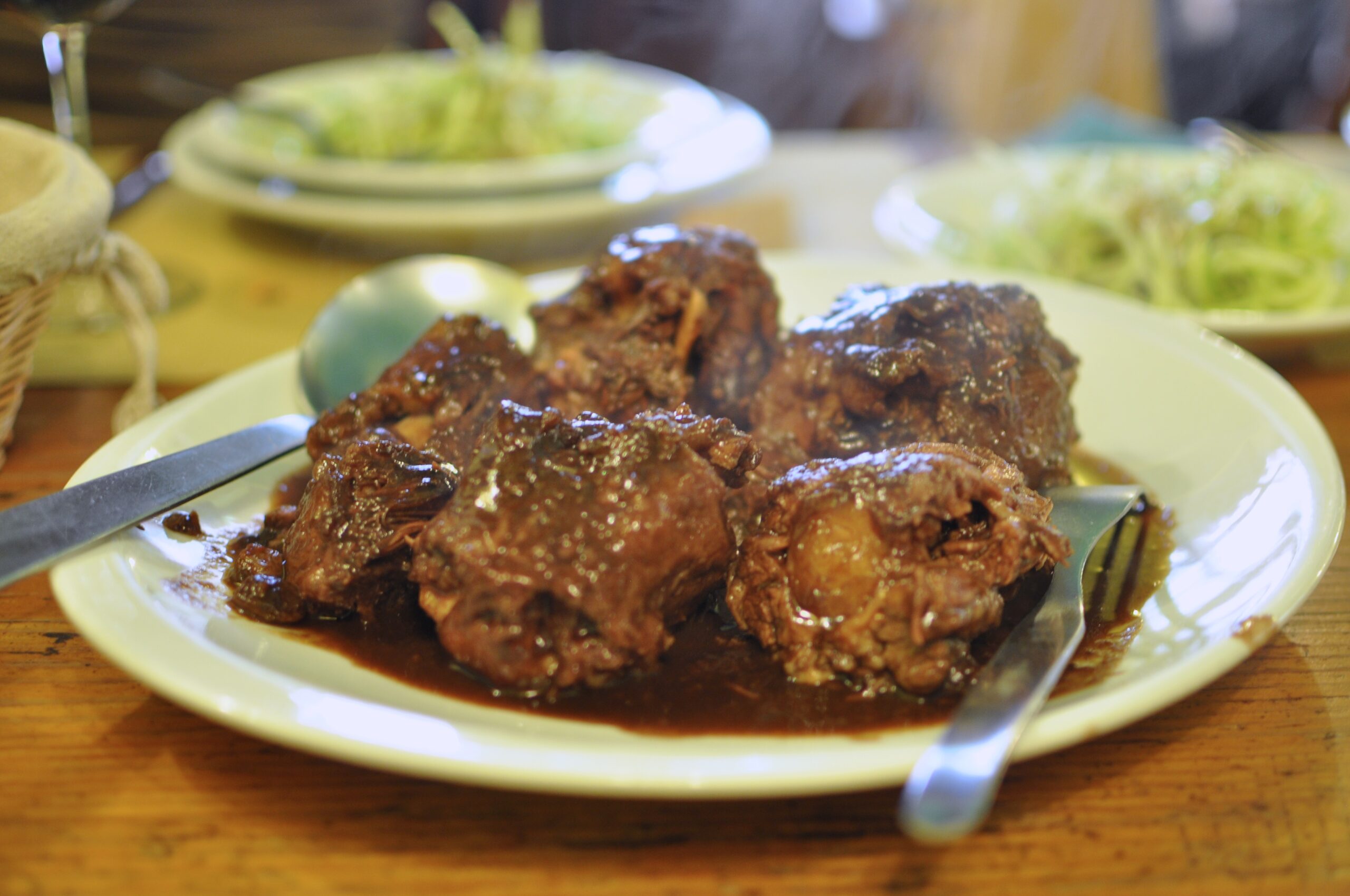
    Coda alla vaccinara

    Here I’ve compiled a menu of Agustarello’s must-try specialties. Stick to this menu and you’ll walk away having experienced the authentic Roman philosophy on life and food away from the tourist circuit. (Important note: I recommend having an overflowing basket of their fresh bread on hand to wipe up every last drop of these fabulous dishes.) Puntarelle saladFor primi, I recommend tonarelli alla gricia – a traditional Roman pasta dish, gricia consists of olive oil, Pecorino Romano cheese, and guanciale (cured pork jowl). It’s the epitome of Roman comfort food. For your secondi, try coda alla vaccianara (oxtail prepared in the butcher’s style) with an insalata di puntarelle (chicory salad). The oxtail is stewed to tender perfection and served up drenched in a rich cocoa infused sauce, while crunchy curls of young chicory are dressed in a mixture of olive oil, garlic, and anchovy paste.

    Cherry Crostata

    Wrap up your meal with an espresso and a slice of one of Antonella’s homemade desserts! Pictured above is her crostata di visciole (cherry tart).

    They say the best way to fully appreciate Italian culture (and food) is to sit down to dinner with a Roman and his family in their home. Dining at Agustarello is a lot like that. So if you find yourself exploring the Testaccio neighborhood, make sure to stop in at Agustarello for a meal of classic Roman cuisine!

    Agustarello
    Via Giovanni Branca, 100
    +3906574 6585
     Open: Mon-Sat 12:30-15:00 & 19:30-24:00
  • Bruschetta with Tomato & Olive Oil

    Bruschetta with Tomato & Olive Oil

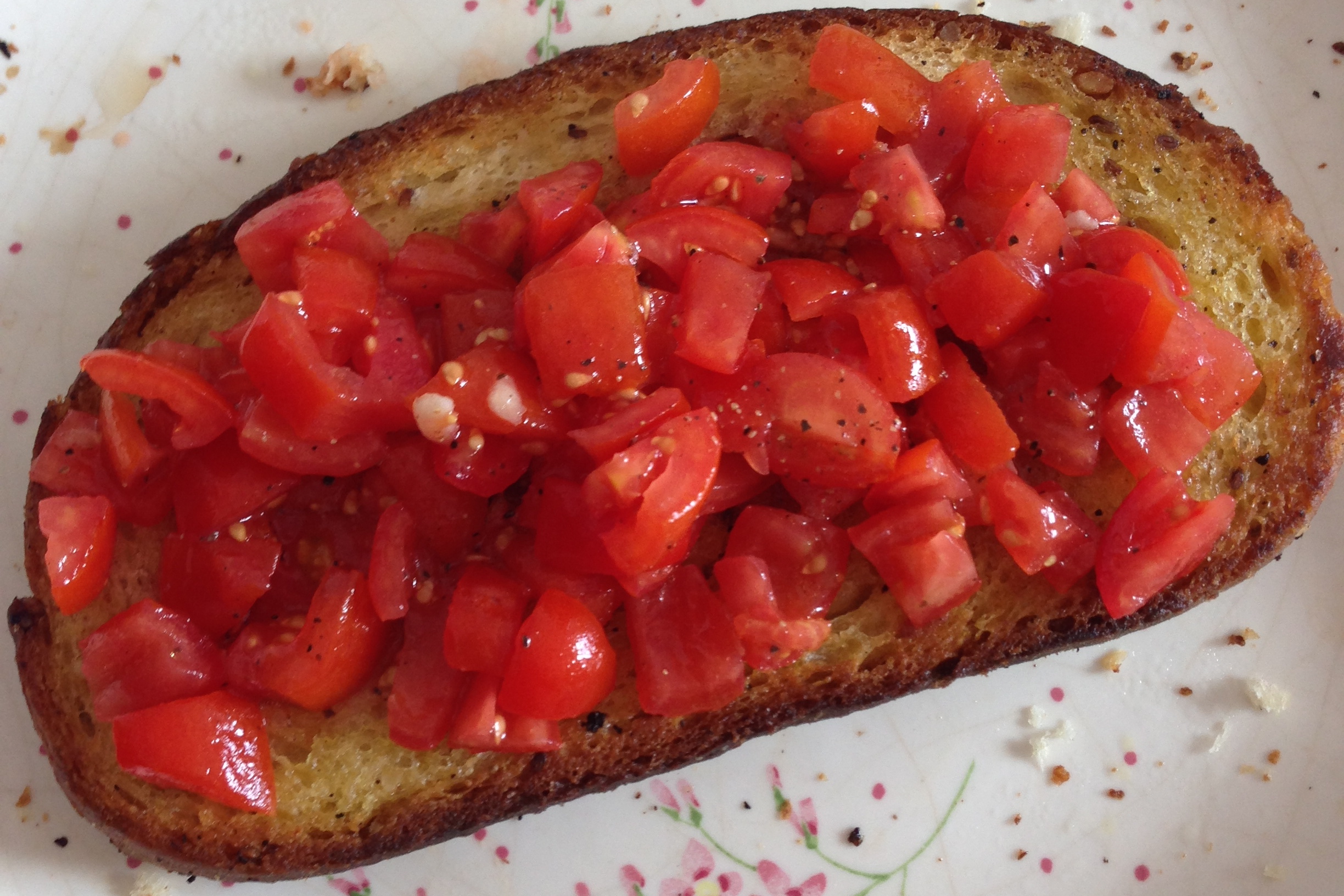
    Bruschetta

    Repeat after me: brew-SKEH-tuh. Bruschetta! One thing that was much debated amongst my family on our first trip to Italy was the pronunciation of this word for toasted bread rubbed with garlic and topped with tomatoes tossed in olive oil. I now know that the proper pronunciation involves a hard “c” sound; though for most Americans this can be a difficult adjustment since we call it “brew-SHET-ta” stateside.

    Pronunciation aside this classic Italian antipasto (appetizer), is delicious no matter what language you eat it in! Bruschetta is my favorite Italian starter. It’s so simple, and yet there’s something almost transcendent about the combination of tomatoes and olive oil – it’s a match made in heaven.

    Here’s my go-to bruschetta recipe, which my Italian roommate taught me on my first night living in Rome.

    Ingredients

    • 1 baguette Italian bread, sliced
    • 1 clove of garlic, peeled
    • Handful of ripe cherry or grape tomatoes, diced
    • Extra virgin olive oil
    • Salt
    • Pepper

    Start by dicing your tomatoes. You can do a rough or a fine chop, depending on preference. In a small bowl, toss diced cherry tomatoes with 1 tbsp of olive oil, and salt and pepper to taste. Set aside.

    Heat 1 tbsp of oil in a medium skillet, swirling around to coat the bottom. Place bread in skillet, flipping to make sure both sides are coated in oil. As the bread toasts, rub each side with garlic clove, rubbing vigorously for strong flavor and gently for milder flavor.

    Heat until bread is golden brown and beginning to darken on both sides. Remove from heat and give it another rub with garlic, if desired. Spoon tomato mixture over toasted bread and enjoy!

  • Caffé vs. Coffee

    Caffé vs. Coffee

    I don’t know about you, but I LOVE coffee. And who doesn’t, really? Warm, comforting, and on occasion life-giving, coffee is an essential part of American life. In Italy, too, coffee is revered as one of the holy grails of the country’s culinary finesse. Italians take their coffee just as seriously as Americans do, if not more.caffe1

    So you would think that two countries that love the hot brown caffeinated drink as much as they do would have a lot in common. But finding common ground between the U.S. and Italy when it comes to coffee is not as easy as you may think (pun intended). Caffè. Coffee. You don’t need to speak Italian to see the glaringly obvious translation. But the similarities end there, because while “caffè” and “coffee” have the same meaning, they actually describe two completely different things.

    Let me break it down for you.

    Drinking caffè in Italy: served in a teeny tiny shot glass or porcelain tazzina (small cup pictured above) full of highly concentrated espresso, to be consumed in five minutes or less while standing at the counter (pictured below). While it’s possible to make special requests on how your coffee is prepared, low-fat or soy milk are rather unpopular.

    20130218-sciascia2Drinking coffee in the U.S.: served in a large paper cup, to be consumed throughout the day or while chatting with friends at the coffee shop. Can be prepared however you like it, with flavored syrups, low-fat or soy milk, or over ice.

    Luckily for me – and all you American coffee lovers as well – it’s possible to bridge the gap between American and Italian coffee cultures.

    Sciascia Caffè, located in the Prati neighborhood of central Rome on Via Fabio Massimo does just that, combining the artistry of Italian coffee with the inviting coziness of your favorite American coffee shop hangouts. It’s the perfect place to meet up with friends for a sit-down coffee, or if you prefer to do as the Romans do, you can have a zippy caffè con cioccolato (espresso with chocolate) at the bar. Either way, the warm, casual ambience, great value, and outstanding quality of Sciascia make it one of my personal favorites, and far and away one of Rome’s best coffee spots.espresso con cioccolato

    Sciascia Caffè
    Via Fabio Massimo 80/A
    Tel +39063211580
     

    See GT Food & Travel’s Best Coffee Bars in Rome for more coffee suggestions.  

  • 3 Cheeses to Taste at Beppe e I Suoi Formaggi

    3 Cheeses to Taste at Beppe e I Suoi Formaggi

    IMG_3092

    Since arriving in Rome, I’ve had to work hard to break out of my all too-comfortable college dining habits:  a lazy dinner of ramen after a long day of classes, squeezing a group of 10 friends around a table at the local pub and ordering five plates of nachos, or (after six hours of field study and lectures) collapsing into chairs at the pizzeria nearest the Forum, disregarding the fact that we know it’s probably one of Rome’s notorious “tourist traps.”

    It’s been a challenge, but every week I force myself to seek out new and exciting dining experiences. And isn’t that the reason food lovers (or anyone for that matter) come to Italy anyway? We want to experience one of the most evolved culinary traditions in the world!

    Beppe e I Suoi Formaggi, or as Romans fondly call it, “Beppe,” is just such a place – a refreshingly authentic Italian culinary experience. All of the cheeses offered in the shop are made by the family of Giuseppe Giovale, the owner of the shop and fourth generation cheese maker from Piedmont. The cheeses are hand-crafted using milk from goats, sheep, and cows that the family itself owns. The Giovale family farm is located in the rolling foothills of Italy’s Piedmont region.

    IMG_3094

    At their store in central Rome, you can have a cheese and wine tasting, sit down for a meal made from seasonal ingredients, or simply buy a hunk of cheese and some prosciutto wrapped up to go. Beppe’s is a little slice of the pastoral dream nestled in the heart of the Eternal City, and the proof is in the pudding! Or rather, the cheese.

    Together with Beppe, we compiled the following list of three must-try cheeses for any first time visitor to the shop!

    1) Giallina – A sweeter cousin of Parmesan, Giallina is a hard cheese made from 100% cow’s milk, and boiled between 30˚-60˚C (a.k.a. semi-pasteurized). The Giallina has larger grains than Parmesan, giving it a different texture. It has all the salty nuttiness of Parmesan, but is sweeter, making it perfectly palatable for a tasting.

    Giallina - sweet, nutty, and granular

    2) Robiola Mista – The Robiola Mista is a soft cheese made from goat and sheep’s milk. It’s aged about 30 days to when it reaches its peak of flavor, and is ideally eaten within a week of its maturation. The flavor can vary, based on when the goats and sheep are milked; the slice of Robiola Mista that we tried in September was herbaceous, since the milk had been gathered during the summer, when the goats and sheep were grazing on fresh summer grass and herbs.

    robiola mista

    3) Erborinato Caprino – Lastly a must for blue cheese fans is this goat’s milk blue with gorgeous flavor. The deep blue-green mold that flecks the cheese has an astonishing effect on the overall taste, turning it earthy, pungent, and tingly. It is described as speziato, which translates to spicy – as in a “spice” such as cardamom – full of pungency and strong flavor. This particular cheese is aged at least 90 days.

    Erborinato Caprino – spicy, pungent, and earthy.

    These are just a few of the many varieties of cheese that Beppe offers. And you don’t have to stick to the list either! Most of the fun at Beppe’s lies in trying whatever is fresh and new for the season. No two cheeses are the same, making a tasting at Beppe’s a true gastronomic adventure.

    For a cheese and wine tasting at Beppe’s, contact us!


Notice: Undefined variable: default in /var/www/vhosts/gtfoodandtravel.com/httpdocs/wp-content/plugins/divi-footer-editor/includes/functions.php on line 82